Public Cloud vs Private Cloud: Which Is Right for Your Business?
Public cloud vs private cloud: Compare costs, security, scalability, and control. Learn which deployment model fits your business needs and budget best.
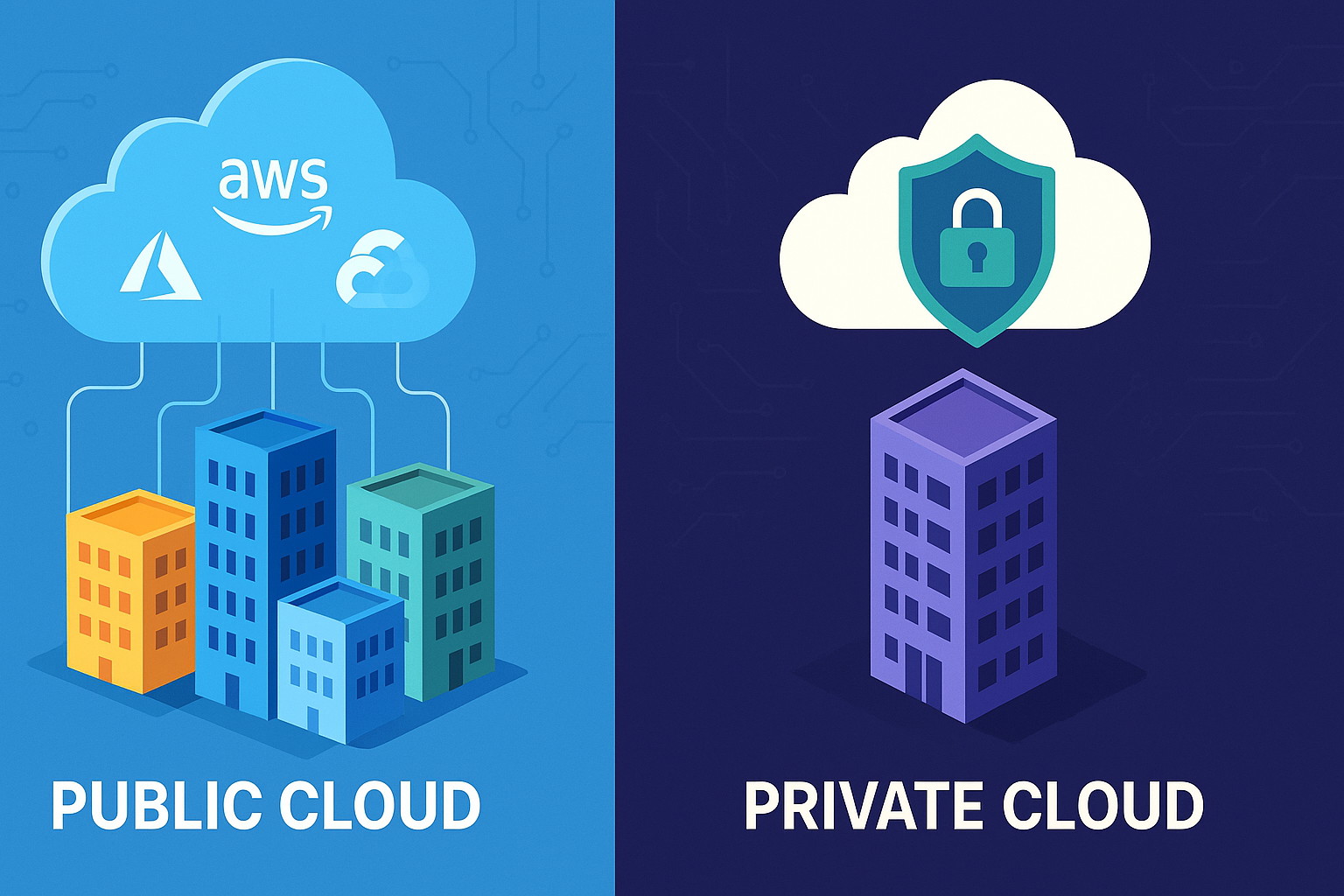
Choosing between public cloud and private cloud isn’t just another IT decision. It’s a strategic choice that affects your company’s budget, security posture, and ability to scale. The global cloud computing market hit $912.77 billion in 2025 and shows no signs of slowing down, with organizations across all industries moving their operations to the cloud. But here’s the thing: not all clouds are created equal.
Some businesses thrive on the flexibility and cost savings of public cloud services, while others need the control and customization that private cloud infrastructure provides. Then there are companies that split the difference with a hybrid approach. The decision depends on your specific needs, compliance requirements, and how much control you want over your data.
In this guide, we’ll break down everything you need to know about public cloud vs private cloud. You’ll learn how each model works, what they cost, who should use them, and which one makes sense for your situation. Whether you’re a startup looking to minimize infrastructure costs or an enterprise dealing with strict regulatory requirements, understanding these cloud deployment models is the first step toward making the right choice for your organization.
Understanding Public Cloud Infrastructure
Public cloud refers to cloud computing resources delivered over the internet by third-party providers. Think of companies like Amazon Web Services (AWS), Microsoft Azure, and Google Cloud Platform. These cloud providers own and operate massive data centers filled with servers, storage systems, and networking equipment that multiple customers share.
The key characteristic of public cloud services is the multi-tenant architecture. Your applications and data live on the same physical infrastructure as other organizations, although they’re logically separated and secured. It’s like renting an apartment in a large building where you have your own space, but you share the building’s foundation, utilities, and some amenities with other tenants.
How Public Cloud Works
When you use public cloud infrastructure, you access computing resources through the internet. You don’t own any hardware or manage physical servers. Instead, you pay for what you use based on a subscription or pay-as-you-go model. Need more storage? You can provision it in minutes. Want to spin up 100 servers for a big project? Done in seconds.
Public cloud providers handle all the heavy lifting: hardware maintenance, software updates, security patches, power management, and cooling systems. Your team focuses on building applications and serving customers rather than managing infrastructure.


Key Benefits of Public Cloud
Public cloud computing offers several compelling advantages that explain why the market is projected to reach over $5 trillion by 2034.
- Lower upfront costs: No need to purchase expensive servers or build your own data center. You avoid the capital expenditure that comes with physical infrastructure.
- Rapid scalability: Scale resources up or down instantly based on demand. During Black Friday sales or tax season, you can handle traffic spikes without overprovisioning year-round.
- Global reach: Major cloud providers operate data centers worldwide, letting you deploy applications closer to your users for better performance.
- Innovation access: Get immediate access to cutting-edge services like artificial intelligence, machine learning, and advanced analytics without building these capabilities yourself.
- Reduced maintenance burden: The cloud service provider handles hardware failures, software updates, and infrastructure management.
Limitations of Public Cloud
Despite its benefits, public cloud isn’t perfect for everyone:
- Less control: You’re working within the provider’s environment and limitations. Customization options are more restricted compared to infrastructure you own.
- Potential compliance challenges: Some industries with strict data sovereignty requirements struggle with public cloud models where data location isn’t always guaranteed.
- Variable costs: While the pay-as-you-go model seems attractive, costs can spiral if you don’t actively monitor and optimize usage. Many companies experience bill shock.
- Shared resources: Performance can occasionally fluctuate during peak usage periods when many tenants demand resources simultaneously.
Understanding Private Cloud Infrastructure
Private cloud is a cloud computing environment dedicated exclusively to a single organization. Unlike the shared model of public cloud, all computing resources in a private cloud belong to one company. This single-tenant architecture provides maximum control and customization.
A private cloud can be hosted on-premises in your own data center, in a colocation facility, or by a third-party provider who dedicates specific hardware to your organization. The defining factor isn’t location but exclusivity. You’re not sharing infrastructure with anyone else.
How Private Cloud Works
In a private cloud deployment, your organization either owns the physical infrastructure or leases dedicated equipment. The environment typically uses virtualization technology to create a pool of computing resources that can be allocated dynamically to different departments or applications within your company.
You maintain complete control over the hardware, software stack, security configurations, and network architecture. This means you can customize everything to meet your specific requirements, from choosing the exact server specifications to implementing proprietary security protocols.
Key Benefits of Private Cloud
Private cloud infrastructure offers advantages that matter most to organizations with specific requirements:
- Enhanced security and control: You determine who accesses what, implement your own security measures, and maintain complete visibility into your infrastructure.
- Regulatory compliance: Easier to meet strict compliance requirements like HIPAA, PCI DSS, or GDPR when you control data location and access completely.
- Customization: Tailor the infrastructure to your exact specifications. Need specific hardware configurations or custom networking setups? You have that flexibility.
- Consistent performance: Dedicated resources mean no performance fluctuations from other tenants competing for computing power.
- Data sovereignty: Keep sensitive data within specific geographic boundaries to meet legal or business requirements.
Limitations of Private Cloud
Private cloud solutions come with trade-offs that make them unsuitable for some organizations:
- Higher costs: Significant upfront investment required for hardware, software licenses, and infrastructure setup. Ongoing costs include maintenance, upgrades, power, and cooling.
- Management complexity: Requires skilled IT staff to maintain and optimize the environment. You’re responsible for everything from security patches to hardware failures.
- Slower scaling: Adding capacity typically means purchasing and installing new hardware, which takes weeks or months rather than minutes.
- Limited geographic reach: Expanding to new regions requires building or leasing additional data centers, a costly and time-consuming process.
Public Cloud vs Private Cloud: Direct Comparison
Let’s compare these cloud deployment models across the factors that matter most to businesses:
Cost Structure
Public cloud follows an operational expenditure (OpEx) model. You pay only for resources you consume, which can start at just a few dollars per month. There are no upfront hardware costs, and you can scale spending up or down as needed. However, costs can become unpredictable if not carefully managed.
Private cloud requires significant capital expenditure (CapEx) upfront. You’re buying servers, storage systems, networking equipment, and potentially building infrastructure. According to industry analysis, the cloud computing market reached $912.77 billion in 2025 90+ Cloud Computing Statistics: A 2025 Market Snapshot, reflecting massive investment in both models. Ongoing operational costs for private cloud include power, cooling, maintenance, and staffing.
Security and Compliance
Public cloud providers invest billions in security infrastructure and employ dedicated security teams. They achieve certifications for numerous compliance frameworks and typically offer security capabilities that individual companies couldn’t build alone. However, you’re trusting a third party with your data.
Private cloud gives you complete control over security implementation. This matters in regulated industries where data sovereignty is non-negotiable. You decide exactly how data is encrypted, who can access it, and where it physically resides.
Scalability and Flexibility
Public cloud wins on scalability. Need 1,000 new servers? They’re available in minutes. Traffic dropped and you need to scale down? Shut off resources instantly and stop paying for them. This elasticity is public cloud’s superpower.
Private cloud scaling is more constrained. You can scale up to the capacity of your existing infrastructure quickly, but adding new capacity requires purchasing and installing hardware. This process takes weeks or months and requires accurate demand forecasting.
Performance and Reliability
Public cloud providers operate globally distributed infrastructure with sophisticated redundancy. Major providers like AWS, Azure, and Google Cloud offer service level agreements (SLAs) guaranteeing 99.9% or higher uptime.
Private cloud performance is more consistent since you’re not sharing resources with other organizations. You control the hardware specifications and can optimize for your specific workloads. However, building the same level of redundancy and geographic distribution requires substantial investment.
Management and Maintenance
Public cloud providers handle infrastructure management, freeing your team to focus on applications and business logic. Updates, security patches, hardware failures, and capacity planning become the provider’s problem.
Private cloud requires dedicated IT staff to manage everything. You need experts in virtualization, networking, storage, security, and more. This overhead can be substantial for smaller organizations.
When to Choose Public Cloud
Public cloud services make sense for many scenarios:
Startups and small businesses benefit tremendously from public cloud because it eliminates the need for upfront infrastructure investment. You can launch quickly, test ideas cheaply, and scale if your business takes off.
Variable workloads are perfect for public cloud. If your computing needs fluctuate significantly, paying only for what you use saves money compared to maintaining enough capacity for peak periods.
Development and testing environments work well in public cloud where you can spin up resources for testing, then destroy them when done. This approach costs a fraction of maintaining permanent infrastructure.
Global applications that need to serve users worldwide benefit from public cloud providers’ global data center networks. You can deploy your application in multiple regions without building your own infrastructure.
When to Choose Private Cloud
Private cloud infrastructure is the right choice when:
Regulated industries like healthcare, finance, and government often require private cloud to meet compliance requirements. When regulations specify exactly where data must reside and who can access it, private cloud provides necessary control.
Sensitive data that you can’t trust to third parties belongs in private cloud. Some organizations have intellectual property, trade secrets, or customer data so sensitive that the shared responsibility model of public cloud doesn’t work.
Predictable workloads can be more cost-effective in private cloud. If you consistently need the same amount of computing power, buying your own infrastructure might cost less than renting it perpetually from a cloud provider.
Custom requirements that public cloud can’t accommodate might necessitate private cloud. Some organizations have proprietary hardware, specialized software, or unique networking needs that only private cloud can satisfy.
The Hybrid Cloud Alternative
Many organizations don’t choose one model exclusively. Hybrid cloud combines public cloud and private cloud, allowing data and applications to move between environments. According to recent market analysis, 90% of organizations have adopted a hybrid cloud approach as of mid-2025.
A typical hybrid approach keeps sensitive data and mission-critical applications in private cloud while using public cloud for less sensitive workloads, development environments, or handling traffic spikes through “cloud bursting.”
This strategy offers flexibility, letting you optimize based on security needs, performance requirements, and cost constraints for each workload. However, it also introduces complexity in managing multiple environments and ensuring they work together seamlessly.
Making Your Decision
Choosing between public cloud vs private cloud requires honest assessment of your needs. Start by evaluating:
Budget constraints: Can you afford the upfront investment for private cloud, or does the OpEx model of public cloud fit better?
Compliance requirements: Do regulations dictate where your data must physically reside and who can access it?
Technical expertise: Do you have the staff to manage private cloud infrastructure, or would you prefer the provider handle it?
Workload characteristics: Are your computing needs predictable or variable? Do they require specific hardware or configurations?
Growth trajectory: How quickly do you need to scale, and in which directions?
For additional perspective on choosing the right cloud strategy, the AWS documentation on cloud deployment models provides comprehensive guidance, while Microsoft Azure’s cloud computing dictionary offers detailed explanations of each approach.
Conclusion
The public cloud vs private cloud decision isn’t about finding the universally “best” option because that doesn’t exist. Public cloud excels at flexibility, scalability, and reducing operational overhead, making it ideal for startups, variable workloads, and organizations without extensive IT staff.
Private cloud provides the control, customization, and security that regulated industries and organizations with sensitive data require, though at higher cost and complexity. Most enterprises are finding that a hybrid approach lets them optimize across both models, keeping critical systems in private cloud while leveraging public cloud for everything else. The key is understanding your specific requirements around budget, compliance, performance, and control, then choosing the cloud deployment model that aligns with your business goals rather than following trends or assumptions about what you “should” do.