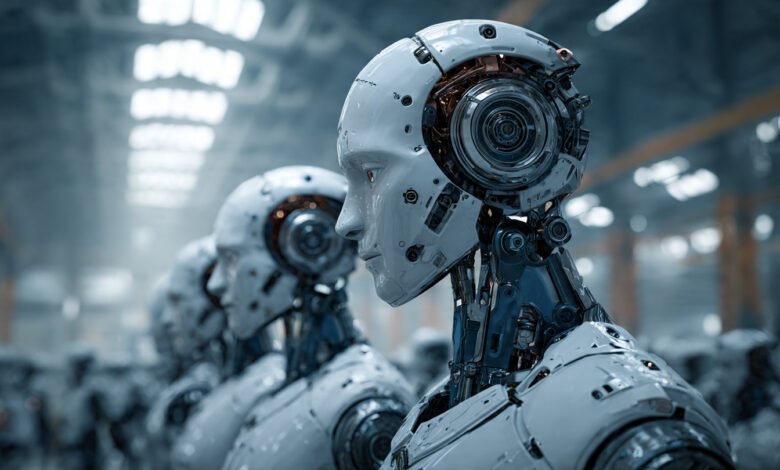
The age of science fiction becoming workplace reality has arrived. Humanoid AI robots are no longer confined to research labs or carefully staged demonstrations. In 2026, these bipedal machines are clocking in for actual shifts at BMW factories, Amazon warehouses, and hospitals across the globe. This isn’t about distant futures or hypothetical scenarios. Companies like Tesla, Boston Dynamics, and Figure AI are deploying robots that walk, lift, and learn alongside human workers right now.
The shift from prototype to production worker happened faster than most experts predicted. Just two years ago, most humanoid robots were limited to controlled environments and promotional videos. Today, they’re handling repetitive manufacturing tasks, moving packages in fulfillment centers, and assisting with patient care. The transformation is driven by three converging forces: breakthrough advances in artificial intelligence, declining production costs, and mounting labor shortages in developed economies. As we move through 2026, the question is no longer whether humanoid robots enter active workforce environments, but how quickly they’ll scale and which industries will adopt them first.
Understanding Humanoid AI Robots in the Modern Workforce
What Makes a Robot Humanoid?
Humanoid AI robots are bipedal machines designed to mimic human form and movement. They typically feature a head, torso, two arms, and two legs, with the ability to navigate spaces built for humans. Unlike traditional industrial robots bolted to factory floors, these machines can walk up stairs, navigate narrow aisles, and adapt to environments designed for human workers.
The defining characteristic goes beyond appearance. Modern humanoid robots workforce integration depends on three critical components:
- AI Systems: Neural networks process sensor data in real time, enabling decision-making and learning from experience
- Mobility: Bipedal locomotion allows access to human spaces without infrastructure modifications
- Manipulation: Articulated hands or grippers perform tasks requiring dexterity and precision
Key Technologies Powering Workforce Humanoids
The technical leap enabling humanoid robots enter active workforce roles stems from recent innovations across multiple domains. Companies are now deploying robots with 20 to 56 degrees of freedom, meaning they can move joints in ways that closely approximate human capabilities.
Sensor Integration forms the foundation. Modern humanoids use cameras, LiDAR, depth sensors, and tactile feedback systems to perceive their environment. Boston Dynamics’ new electric Atlas, unveiled at CES 2026, demonstrates this integration with its ability to autonomously rise from flat positions and interact with unpredictable surroundings.
Embodied AI represents the most significant advancement. This technology integrates intelligence with physical capability, allowing robots to perceive, reason, and act autonomously. Google DeepMind’s partnership with Boston Dynamics brings Gemini Robotics AI to Atlas, enabling the robot to reason through complex instructions and operate in unstructured environments. The collaboration exemplifies how AI breakthroughs are translating directly into mechanical intelligence.


7 Leading Humanoid Robots Transforming Active Workforce Roles
1. Boston Dynamics Atlas: Industrial Powerhouse
The production-ready electric Atlas represents a landmark achievement in industrial automation. With 56 degrees of freedom, a 7.5-foot reach, and 110-pound lifting capacity, this humanoid robot is purpose-built for continuous operation in manufacturing environments.
Hyundai will deploy initial Atlas units in 2026 at its Metaplant facility in Georgia. The robot’s non-human joint articulation allows movements impossible for wheeled systems, making it ideal for complex material handling and order fulfillment tasks. Battery runtime of 4 hours with hot-swappable capability ensures minimal downtime.
2. Tesla Optimus Gen 2: General-Purpose Versatility
Tesla’s Optimus Gen 2 brings the company’s AI expertise to humanoid robots workforce applications. Designed for both industrial and domestic tasks, Optimus features improved joint articulation and learns from real-world data collected across deployments.
The robot’s cost trajectory is particularly notable. With production scaling, Tesla aims to reduce unit costs to levels that make workforce automation economically viable for mid-sized manufacturers, not just tech giants.
3. Figure 02: BMW’s Factory Worker
Figure AI has moved beyond pilot programs to actual production deployment. Figure 02 operates at BMW’s South Carolina manufacturing plant, handling repetitive tasks that previously required human workers. The company raised $1.5 billion in funding, reflecting investor confidence in practical humanoid robot applications.
Real-world deployment reveals both capabilities and limitations. Figure 02 excels at structured, repetitive motions but still requires human oversight for task switching and problem-solving. This hybrid model reflects the current state of humanoid robots enter active workforce implementation across industries.
4. Agility Robotics Digit: Logistics Specialist
Digit has established itself as the go-to solution for warehouse automation. GXO deployed Digit units in its Georgia warehouse in 2024, with expanded rollout planned for 2026. The robot’s human-like gait allows it to navigate loading docks, ramps, and uneven surfaces that challenge wheeled systems.
Production capacity at Agility’s RoboFab facility is ramping from hundreds to thousands of units. The company’s focus on logistics addresses a critical pain point: e-commerce fulfillment centers struggle with high turnover and seasonal labor demands. Digit handles tote lifting, package sorting, and transport between warehouse zones.
5. 1X NEO: Home and Service Applications
1X opened preorders for NEO in 2026, marking the first consumer-facing humanoid robot with firm delivery commitments. NEO combines lightweight construction with quiet electric actuation, designed specifically for safe operation in home environments.
The robot learns tasks through human guidance and teleoperation, gradually increasing autonomy. Initial capabilities focus on household activities including object handling, tidying, and basic assistance. NEO represents the bridge between industrial humanoid robots workforce applications and eventual consumer adoption.
6. Unitree G1: Cost-Effective Agility
Unitree’s G1 addresses the cost barrier that has limited humanoid robot adoption. Priced at approximately $16,000, the G1 makes bipedal automation accessible to smaller operations. The robot optimizes for rapid, agile movement in compact spaces where efficiency matters more than raw lifting capacity.
Service industries and research facilities are early adopters. The G1’s affordability allows companies to experiment with workforce automation without massive capital commitments. While it lacks the sophistication of premium models, it proves that practical humanoid robots don’t require six-figure investments.
7. NEURA Robotics 4NE-1: Collaborative Intelligence
NEURA’s third-generation 4NE-1, unveiled at CES 2026, emphasizes human-robot collaboration. The robot features patented artificial skin that detects proximity to prevent collisions, addressing safety concerns that slow adoption in shared workspaces.
The Neuraverse operating system allows robots to share learned skills across fleets in real time. This collective intelligence approach accelerates capability development and reduces training costs. With lifting capacity up to 100 kilograms and high-torque joints, 4NE-1 handles both industrial automation and domestic assistance scenarios.
Industries Adopting Humanoid Robots First
Manufacturing: The Natural Starting Point
Manufacturing robots represent the largest current deployment category for humanoid AI robots. Auto manufacturers lead adoption, with Mercedes-Benz testing Apptronik’s Apollo alongside BMW’s Figure 02 installations. These early programs focus on repetitive, physically taxing tasks where labor shortages create immediate business pressure.
The economics are compelling. McKinsey research indicates that physical tasks make up more than half of working hours for about 40% of the US workforce. As unit costs for advanced robots drop from $150,000 to $20,000-$50,000, return on investment calculations shift dramatically in favor of automation.
Logistics and Warehousing: Solving Labor Challenges
The e-commerce boom created sustained demand for warehouse workers that companies struggle to fill. Amazon currently operates 750,000 robots spanning nine specialized categories, and the company is now trialing humanoid robots for last-mile deliveries.
Warehouse automation using humanoid robots workforce solutions addresses specific pain points:
- 24/7 operation without shifts or breaks
- Consistent performance across repetitive tasks
- Flexibility in facilities not designed for fixed automation
- Scalability to handle seasonal demand spikes
Digit’s pilot programs at major logistics companies demonstrate that bipedal robots can navigate existing infrastructure without expensive retrofits. This brownfield advantage is crucial for widespread adoption.
Healthcare: Addressing Demographic Pressures
Healthcare represents a longer-term but potentially massive opportunity for humanoid robots enter active workforce scenarios. Aging populations in Germany, Japan, South Korea, and China intensify workforce challenges that robots could partially address.
Current applications focus on support roles rather than direct patient care. Robots handle hospital supply delivery, equipment sanitization, and patient mobility assistance. As AI capabilities improve and safety certifications advance, more sophisticated medical support roles become feasible.
Retail and Service: Customer-Facing Roles
Service environments present unique challenges requiring nuanced human interaction. However, humanoid robots are beginning to appear in customer-facing roles where consistency and availability matter more than social sophistication.
Realbotix deployed a humanoid robot at Ericsson for workforce training, visitor engagement, and career guidance. The robot’s proprietary vision technology autonomously detects movement and emotions, remembers faces, and responds accordingly during interactions. These implementations test whether customers accept robot assistance in traditionally human domains.
Economic Impact and Market Projections
Market Size and Growth Trajectory
The global humanoid robot market is experiencing exponential growth. Multiple research firms project dramatic expansion:
- MarketsandMarkets forecasts the market reaching $13-22 billion by 2032, growing at 38-49% annually
- Morgan Stanley predicts the market could exceed $5 trillion by 2050 with one billion units deployed
- Bank of America estimates 18,000 units shipping in 2025, scaling to 1 million annually by 2030-2035
These projections reflect not just robot sales but entire ecosystems including maintenance infrastructure, supply chains, and related services. Morgan Stanley notes the humanoid robots workforce market could be twice the size of the auto industry within decades.
Cost Trajectories and ROI Considerations
Between 2022 and 2024, unit costs for humanoid robots dropped by at least 40%. This acceleration continues as production scales and component costs decline. The economic case strengthens as robots approach cost parity with human labor.
Consider the math: Unitree’s $16,000 robot matches the annual cost of minimum wage in the United States and comes well below skilled worker compensation. When robots operate multiple shifts without benefits, overtime, or turnover costs, the ROI calculation shifts dramatically.
Companies piloting humanoid robots enter active workforce programs report varying payback periods depending on application:
- Manufacturing line tasks: 18-36 months
- Warehouse picking: 24-48 months
- Maintenance and inspection: 36-60 months
These timelines assume continued capability improvements and declining equipment costs. Early adopters accept longer paybacks to gain experience and competitive positioning.
Geographic Distribution and Competition
China holds 61% of robotics unveilings since 2022 and controls 70% of component supply chains. The US-China competition in artificial intelligence and robotics drives rapid innovation but also creates supply chain concerns for Western companies.
According to the Stanford AI Index Report, 83% of AI intellectual property and 90% of notable foundation models come from China and the US. This concentration means humanoid robots come almost exclusively from these two countries, with implications for technology transfer and national competitiveness.
Challenges and Limitations Facing Humanoid Robot Adoption
The Autonomy Gap Reality
Despite impressive demonstrations, most humanoid robots workforce deployments remain pilot programs heavily dependent on human supervision. Current robots excel at specific, structured tasks but struggle with dynamic problem-solving and task switching.
The “autonomy gap” is real and often obscured in promotional videos. MIT Technology Review reports that demonstrations frequently mask technical constraints through staged environments or remote supervision. True autonomous operation in unstructured settings remains limited for most commercial robots.
This parallels lessons from autonomous vehicles. Initial predictions proved wildly optimistic. Scaled deployment requires a phased approach: controlled environments first, building trust through proven performance, then gradual expansion to complex scenarios.
Safety and Regulatory Challenges
Humanoid robots enter active workforce environments only with rigorous safety protocols. The International Organization for Standardization (ISO) is developing standards for “industrial mobile robots with actively controlled stability,” which covers most bipedal designs.
Safety concerns stem from several factors:
- Power loss risks: Most bipedal robots collapse when power fails, creating hazards for nearby workers and equipment
- Unpredictable movement: Dynamic balance systems can react unexpectedly to disturbances
- Force application: Robots with 110-pound lifting capacity pose collision risks in shared spaces
- Software failures: AI decision-making errors could lead to dangerous actions
Regulatory pathways remain unclear in many jurisdictions. Companies deploying robots navigate patchwork regulations not designed for autonomous mobile systems.
Battery Life and Physical Limitations
Current humanoid robots operate for 2-20 hours depending on task intensity, with most industrial units averaging 4-8 hours. Hot-swappable batteries extend operational time but add complexity and cost.
Physical capabilities still lag human benchmarks in several areas:
- Dexterity: Robot hands struggle with small object manipulation and tool use
- Speed: Walking and manipulation speeds remain slower than human workers
- Adaptability: Switching between task types requires reprogramming or retraining
- Durability: Mechanical joints require regular maintenance and have limited operational lifespans
These limitations constrain practical applications. Tasks requiring fine motor control, rapid adaptation, or extended operation without maintenance remain challenging for current humanoid robots workforce models.
Cost Barriers for Widespread Adoption
While costs are declining, humanoid robots remain expensive. Full-size industrial units typically cost $50,000-$150,000, with advanced models exceeding $250,000. For small and medium businesses, this represents a significant capital investment with uncertain returns.
The total cost of ownership includes:
- Initial hardware purchase
- Installation and facility modifications
- Staff training on operation and safety
- Ongoing maintenance and repairs
- Software updates and capability enhancements
- Battery replacements and consumables
These factors mean that only large enterprises or well-funded operations can currently justify humanoid robot investments. Mass adoption requires further cost reductions and clearer ROI demonstrations.
The Human Factor: Workforce Impact and Collaboration
Job Displacement Concerns and Reality
The question of whether humanoid robots workforce integration will destroy jobs generates heated debate. Historical evidence from industrial robot adoption shows localized employment effects that eventually stabilize as economies adapt.
Research from the National Bureau of Economic Research links industrial robot spread to temporary job losses and wage depression in affected areas before new roles emerge. The pattern suggests displacement is real but not permanent.
Physical tasks currently make up more than half of working hours for positions including:
- Drivers and material handlers
- Construction workers
- Cooks and food service workers
- Healthcare aides
- Maintenance and cleaning staff
Humanoid robots enter active workforce roles in these sectors gradually, starting with the most repetitive and physically demanding tasks. This phased approach allows time for workforce adaptation and retraining.
New Job Categories Emerging
Workforce automation doesn’t just eliminate jobs; it creates new roles requiring different skills. Companies deploying humanoid robots report emerging positions including:
- Robot fleet managers: Overseeing operations, scheduling, and performance optimization
- Training specialists: Teaching robots new tasks through teleoperation and demonstration
- Maintenance technicians: Performing repairs, updates, and preventive maintenance
- Safety coordinators: Ensuring compliant operation and investigating incidents
- Integration engineers: Adapting workflows to incorporate robot capabilities
These roles emphasize supervision, problem-solving, and technical expertise rather than physical labor. The transition requires workforce development programs and educational initiatives to prepare workers for human-robot collaboration.
Human-Robot Collaboration Models
The most successful humanoid robots workforce implementations don’t replace humans entirely but create hybrid teams leveraging complementary strengths. Humans provide judgment, creativity, and adaptability. Robots offer consistency, endurance, and precision.
Mercedes-Benz’s Apollo pilot exemplifies this approach. The humanoid robot handles repetitive, physically taxing tasks in areas with labor shortages, while human workers focus on complex assembly requiring dexterity and decision-making. This collaboration model addresses workforce gaps without wholesale displacement.
Studies show that employee acceptance improves when robots augment rather than replace. Companies that frame humanoid robots as tools helping workers rather than competition face less resistance and achieve smoother integration.
Future Outlook: What’s Next for Humanoid Robots in the Workforce
Near-Term Developments (2026-2028)
The next two years will test scaled deployment beyond pilot programs. Agility Robotics plans to ramp Digit production from hundreds to thousands of units. Boston Dynamics’ Atlas will expand beyond Hyundai’s initial installation. Figure AI continues BMW deployments while pursuing additional manufacturing partners.
Expect modest growth focused on specific applications where humanoid robots deliver clear value:
- Warehouse order picking and package sorting
- Manufacturing line feeding and material handling
- Facilities maintenance in large industrial complexes
- Hospital logistics for supply delivery
These near-term applications share characteristics: structured environments, repetitive tasks, and labor shortage pressure creating economic justification.
Mid-Term Evolution (2028-2032)
As AI capabilities advance and costs decline further, humanoid robots workforce integration will accelerate. Improvements in several areas will expand addressable applications:
Enhanced autonomy through better vision-language models and reinforcement learning will reduce human oversight requirements. Robots will handle task switching and problem-solving with less intervention.
Improved dexterity from advances in actuators and control systems will enable fine manipulation tasks currently impossible. This opens applications in assembly, inspection, and quality control.
Extended runtime from better batteries and energy efficiency will support continuous operation. All-day shifts without charging become standard, improving economics.
Specialized designs for specific industries will emerge. Healthcare robots, construction robots, and agricultural robots with form factors optimized for their domains will supplement general-purpose platforms.
Long-Term Transformation (2032+)
Beyond the next decade, humanoid robots enter active workforce environments at scale across most industries. Morgan Stanley’s prediction of one billion units by 2050 reflects this trajectory, though critics call such projections wildly optimistic.
The long-term vision includes:
- Consumer-level models for household tasks, eldercare, and personal assistance reaching homes in the late 2020s
- Collaborative ecosystems where multiple robot types work together with humans in shared spaces
- Cross-manufacturer interoperability enabling unified operational environments similar to Amazon’s current 750,000-robot fleet
- AI advancement potentially enabling general-purpose robots that learn and adapt across diverse tasks with minimal human guidance
This transformation depends on resolving current limitations, building public trust, and creating regulatory frameworks. The technology trajectory suggests capability will improve faster than social and institutional adaptation.
Wild Cards and Uncertainty Factors
Several factors could accelerate or slow adoption:
Breakthrough AI advances could dramatically shorten the timeline to capable general-purpose robots. Conversely, an AI capability plateau would extend the path to true autonomy.
Economic shifts including recessions, labor market changes, or capital availability will affect corporate willingness to invest in humanoid robots workforce automation.
Regulatory responses range from supportive policies encouraging innovation to restrictive frameworks limiting deployment. Government approaches will vary by country and significantly impact adoption rates.
Public acceptance remains uncertain. Negative incidents, privacy concerns, or cultural resistance could slow integration even as technical capability improves.
Strategic Considerations for Businesses and Workers
For Business Leaders: When to Invest
Companies considering humanoid robots enter active workforce investments should assess readiness across multiple dimensions:
Operational readiness: Do you have workflows suitable for automation? Areas with repetitive physical tasks, labor shortages, or safety concerns offer strong starting points. Infrastructure capable of supporting robot charging, maintenance, and operation is essential.
Financial readiness: Beyond purchase price, consider total cost of ownership including installation, training, maintenance, and facility modifications. Pilot programs reduce risk by proving ROI before large-scale deployment.
Organizational readiness: Does your culture support innovation and change? Successful humanoid robots workforce integration requires buy-in from workers, managers, and executives. Communication about augmentation rather than replacement helps build acceptance.
Technical readiness: Do you have personnel capable of programming, maintaining, and optimizing robot operations? Partnerships with vendors offering turnkey solutions and ongoing support can bridge capability gaps.
For Workers: Adapting to Change
Individuals in industries likely to see humanoid robot adoption should proactively develop skills that remain valuable in automated environments:
Technical skills: Understanding robot programming, maintenance, and troubleshooting creates job security. Online courses and certifications in robotics and AI are increasingly accessible.
Soft skills: Creativity, emotional intelligence, complex problem-solving, and leadership remain difficult to automate. These capabilities complement rather than compete with robot strengths.
Adaptability mindset: The pace of technological change requires continuous learning and flexibility. Workers who embrace change and seek new opportunities navigate automation transitions more successfully.
Collaborative skills: Working effectively with humanoid robots requires understanding their capabilities and limitations. Early exposure through training programs or pilot projects builds confidence and competence.
Conclusion
The arrival of humanoid AI robots in active workforce roles marks a genuine inflection point in automation history. Unlike previous waves of robotics confined to fixed stations or wheeled platforms, humanoid robots navigate human environments and perform tasks previously requiring human form and intelligence. The convergence of artificial intelligence breakthroughs, declining costs, and mounting labor shortages is accelerating adoption across manufacturing, logistics, healthcare, and service industries. While challenges around autonomy, safety, and cost remain significant, the trajectory is clear: these machines are moving from research demonstrations to real work. The seven leading robots profiled here represent just the beginning of a transformation that will reshape how we think about work, productivity, and human-machine collaboration. Companies and workers who understand this shift and prepare accordingly will be better positioned to thrive as humanoid robots enter active workforce environments at scale over the coming decade. The revolution isn’t coming—it’s already clocking in for the morning shift.