AI Video Analytics, LiDAR or Network Radar? Choosing Perimeter Detection for a Luxury Estate
MSB Protection designs advanced security systems using AI video analytics, LiDAR, radar, and perimeter sensors to detect intrusions and protect people and assets.
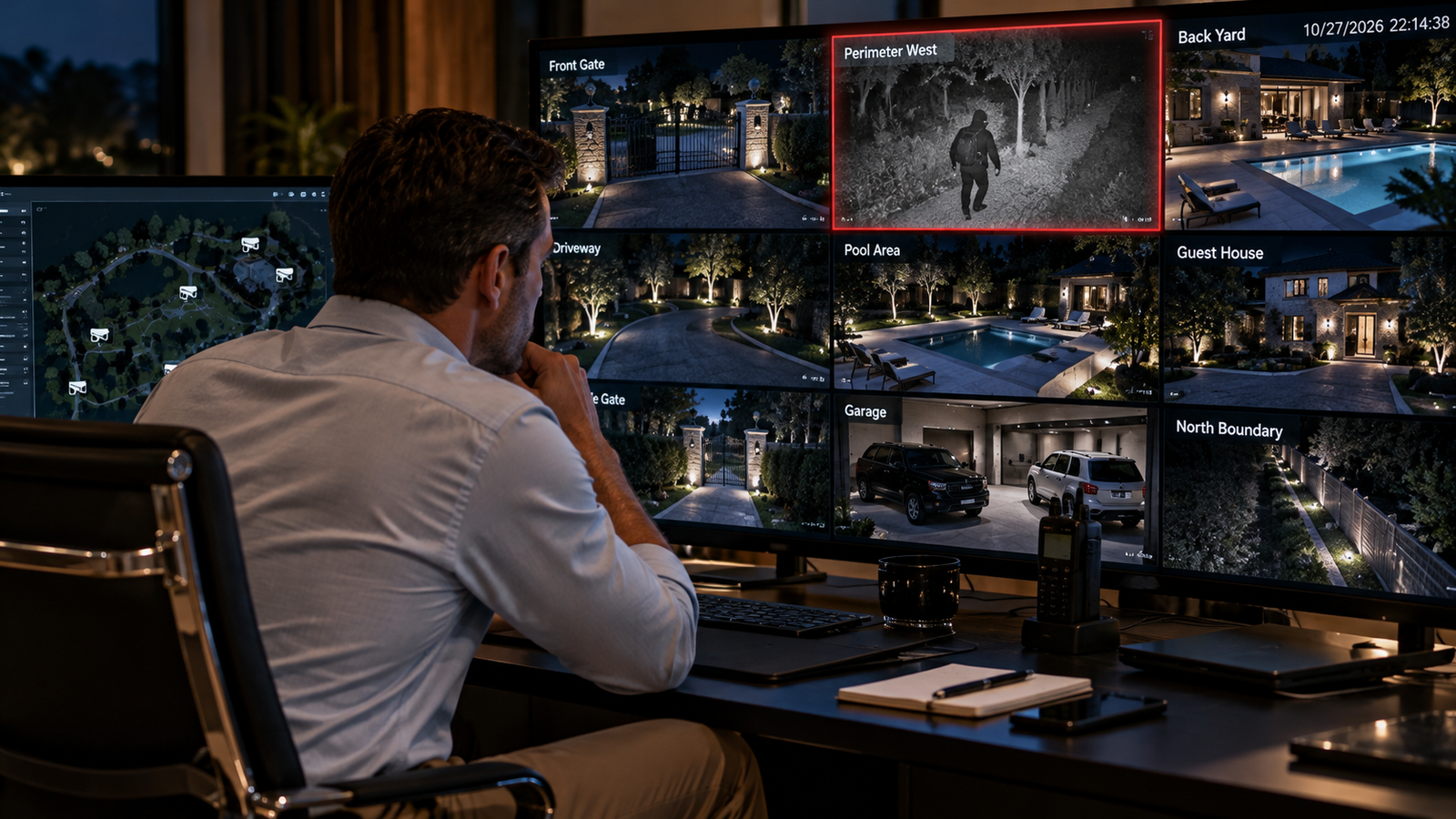
When I ask owners of luxury estates who would know if someone climbed over their back wall in the middle of the night, the answer is frequently revealing.
“We have cameras everywhere.”
Sometimes they add: “Our security officer is watching them.”
But that doesn’t necessarily mean anyone would recognize an intrusion while it was happening.
A camera can record someone entering a property without anyone noticing until hours later. Even the most sophisticated surveillance system provides limited protection if it cannot alert the right person early enough to act.
Research has challenged the assumption that continuous camera monitoring is dependable for decades. A U.S. Department of Justice guide prepared by Sandia National Laboratories highlighted experiments in which human attention deteriorated significantly after approximately 20 minutes of continuous video monitoring.
Although the research predates modern AI analytics and should not be interpreted as a universal performance limit, the operational lesson remains relevant.
Technology should direct the protector’s attention, not demand that attention continuously.


At MSB Protection, our approach is to design security around early detection, reliable assessment and a coordinated response. Whether protecting a private residence or a large estate, the objective is to identify a potential intrusion before it becomes an immediate threat to the people or assets we protect.
Today, AI video analytics, LiDAR, network radar and traditional perimeter sensors offer more options than ever.
The challenge is knowing which technologies actually improve protection.
Why This Matters in 2026
Perimeter detection is undergoing a significant technological transformation.
In August 2026, the Security Industry Association’s report on its Perimeter PREVENT conference highlighted how LiDAR, thermal imaging, artificial intelligence and integrated monitoring systems are changing perimeter protection.
An important theme was that having numerous sensors does not necessarily mean an organisation understands what is happening along its perimeter.
Equipment may detect movement, but without coordination, contextual information and clear response procedures, operators can still miss important events.
Manufacturers are addressing this challenge with increasingly integrated systems.
For example, in January 2026, Axis Communications announced its D2122-VE and D2123-VE network radar systems, designed to combine broad-area detection and AI-assisted classification with compatible pan-tilt-zoom cameras.
Depending on the configuration, these systems can help locate detected movement, direct cameras towards the activity and combine information from multiple sensors.
Those capabilities illustrate the direction in which perimeter technology is developing. They are not evidence that any particular product is appropriate for every estate.
The value comes from how the technology is selected, positioned, integrated and operated.
For owners of luxury properties, this distinction is essential.
A sprawling estate with wooded boundaries, multiple structures and significant changes in elevation presents very different detection challenges from a smaller property with clear sightlines and a relatively simple perimeter.
The right solution begins with the property, not a product catalogue.
Start With the Risk, Not the Equipment
Enterprise Security Risk Management, or ESRM, provides the framework we use to approach these decisions.
At its core, ESRM treats security as a partnership between security professionals and those who own the assets being protected.
For a luxury estate, those assets may include the principal and family members, staff, private residences, valuable collections, sensitive information and the ability to enjoy the property safely and privately.
The first step is identifying and prioritising what matters most.
The next is identifying the threats and vulnerabilities that could affect those assets.
Only then should we determine which protective measures are appropriate.
A residence situated near a publicly accessible hiking trail may require particular attention to its outer boundary. A property with substantial landscaping may present challenges involving obstructed sightlines, wildlife and environmental conditions.
A private collection containing valuable artwork may need protection that functions independently of the general perimeter.
Not every risk requires the same investment.
The property owner ultimately decides which risks to accept and which require additional mitigation. Security professionals explain the exposures, evaluate alternatives and recommend practical solutions.
For perimeter protection, an especially important consideration is where detection begins in relation to the asset being protected.
Detecting someone at a bedroom window is very different from identifying unauthorised movement near an outer property boundary.
The earlier a credible intrusion can be recognised, the greater the opportunity for appropriate intervention.
That time must be considered alongside physical barriers, security personnel, communications and established emergency procedures.
A Real-World Failure: The 2025 Louvre Jewelry Theft
The October 19, 2025 theft of French crown jewels from the Louvre Museum in Paris provides a particularly instructive example of why surveillance equipment alone is insufficient.
Although a museum is different from a private estate, the underlying challenges of perimeter detection, protecting valuable assets and responding to alarms are directly relevant.
Following the theft, France’s Ministry of Culture published findings from an administrative investigation.
The investigation identified longstanding weaknesses in security risk assessment, insufficient external surveillance equipment and problems involving security governance and responsibility.
Importantly, the ministry reported that the alarms had functioned and personnel had followed established procedures.
Yet the theft was not prevented.
Subsequent reporting on testimony before the French Senate revealed additional concerns.
A camera inside the targeted gallery captured activity associated with the break-in, but the relevant video was not being actively monitored in a way that allowed sufficiently early intervention.
Investigators also identified limitations in the number of surveillance screens available and delays affecting the response.
According to the inquiry, a difference of approximately 30 seconds might have created an opportunity to prevent the thieves’ escape. That was an investigative assessment, not a guarantee of a different outcome.
The incident demonstrates something every estate owner should understand.
An alarm can function correctly, a camera can record an intrusion, and the overall security system can still fail to protect the asset.
The lesson is not that the Louvre should simply have installed more cameras.
Effective protection requires detection at an appropriate location, physical measures that delay unauthorised access, technology that presents actionable information and personnel capable of responding.
For private estates containing valuable artwork, jewelry or other sensitive assets, those distinctions deserve particular attention.
AI Video Analytics: Powerful, but Limited by What Cameras Can See
Modern AI video analytics can identify particular types of objects and activities rather than simply registering changes in an image.
Depending on the system, analytics may classify people or vehicles, monitor virtual boundaries, identify movement into restricted zones and generate alerts based on configured conditions.
For example, a camera covering a private driveway might distinguish a person entering a designated restricted area from routine movement outside the property.
This can dramatically improve how security personnel use surveillance technology.
Instead of expecting an officer to monitor numerous camera feeds continuously, the system highlights activity requiring attention.
However, AI analytics have an important limitation.
A camera cannot reliably analyse something it cannot see.
Fog, heavy rain, glare, poor lighting, dirty lenses and overgrown landscaping can all affect performance.
A camera positioned with an excellent view during installation may become partially obstructed as vegetation grows.
There is also a fundamental distinction between detecting a person and determining whether that person is authorised.
An AI system may correctly classify someone walking through a garden while having no way of knowing whether the individual is a family member, employee, contractor or intruder.
That determination requires operational context.
At MSB Protection, we favour analytics configured around clearly defined detection zones and established procedures.
AI should help identify activity deserving attention. It should not independently determine whether someone represents a threat.
LiDAR: Understanding Movement in Three Dimensions
LiDAR, or light detection and ranging, uses laser pulses to measure distances and build a three-dimensional representation of its surroundings.
For luxury estates, this creates interesting possibilities.
A properly designed LiDAR installation can monitor movement within a defined space, identify objects entering restricted zones and provide spatial information about their location.
Unlike conventional video, LiDAR does not rely solely on the appearance of objects within a two-dimensional image.
This can be useful where an estate has complex landscaping, defined approach areas or multiple detection zones.
But LiDAR is not immune to environmental challenges.
Heavy rain, fog, airborne particles and certain reflective or absorptive surfaces can interfere with measurements.
Dense vegetation may obstruct detection. Irregular terrain can create blind spots.
Sensor placement matters enormously.
An expensive sensor mounted at an unsuitable height or angle may leave significant areas unprotected.
As with every detection technology, performance should be demonstrated under the actual conditions of the property.
A well-designed conventional sensor arrangement can outperform a poorly planned LiDAR installation.
Network Radar: Detection Without Relying on Visible Light
Network radar uses radio-frequency signals to detect objects and estimate characteristics such as distance, location and movement.
Unlike conventional optical cameras, radar does not require visible illumination.
Depending on the equipment and operating conditions, it can detect movement during darkness, fog and other conditions that may significantly reduce camera performance.
This makes radar particularly interesting for large estates with extensive outdoor areas.
One valuable capability is integration with compatible pan-tilt-zoom cameras.
When radar identifies movement within a defined zone, the system may direct a PTZ camera towards the location so security personnel can examine the activity.
The radar supplies location and movement information.
The camera provides visual context.
Analytics may assist with classification.
A trained protector evaluates the information and determines the appropriate response.
However, radar is not a universal solution.
Walls, buildings, changes in terrain and other structures may obstruct coverage.
Reflections can complicate tracking. Moving vegetation, wildlife and activity beyond the intended boundary may cause nuisance alarms.
Radar performance must therefore be assessed against the estate’s physical environment and the specific type of intrusion the system is expected to detect.
An automatically directed PTZ camera should also complement, rather than necessarily replace, fixed-camera coverage.
A moving camera may be observing one event while another develops elsewhere.
Infrared Beams and Thermal Cameras Still Have Their Place
The newest technology is not always the best choice.
Traditional active infrared beams remain valuable for identifying crossings along clearly defined boundaries.
A transmitter sends an infrared signal to a receiver. When the beam is interrupted under the configured conditions, the system generates an alarm.
These systems can be effective where the terrain and layout support reliable alignment.
However, vegetation growth, wildlife, precipitation and changes in the surrounding environment must be considered.
Thermal cameras offer another option.
Rather than relying on visible light, they detect thermal radiation and can help identify people or animals in low-light environments.
Like other sensors, their performance depends on conditions, positioning, target characteristics and environmental limitations.
No single technology should be assumed to provide perfect coverage.
For some properties, a combination of radar, video analytics, infrared beams and other sensors may be appropriate.
For others, a simpler system may provide more dependable protection.
The best sensor is not necessarily the most expensive or technologically advanced. It is the one that performs the required detection task reliably in that specific environment.
False Alarms Can Undermine an Excellent Security System
Outdoor intrusion detection presents a problem that technology manufacturers cannot simply ignore: normal activity.
Trees move in the wind. Animals cross boundaries. Irrigation systems activate. Landscapers enter service areas. Weather changes visibility.
If every event produces an urgent alarm, security personnel can become overwhelmed.
Over time, excessive nuisance alarms may encourage operators to reduce system sensitivity, disregard notifications or disable troublesome detection zones.
This can undermine the system’s original purpose.
Nuisance sources should therefore be evaluated during design, installation and commissioning.
One promising approach is sensor fusion: combining information from different technologies to produce a more useful assessment.
For example, radar may detect movement in a restricted area while video analytics determines whether a visible object appears to be a person.
When both systems provide consistent information, the resulting alert may offer stronger evidence than either sensor alone.
Sandia National Laboratories has published research on fused radar and video analytics, demonstrating how combined sensor information can help distinguish deliberate movement from nuisance events associated with weather and vegetation.
However, correlation rules must be designed carefully.
A credible radar detection should not necessarily be dismissed because a camera fails to provide confirmation.
The camera may be obstructed, visibility may be poor or the video analytics may have failed.
The objective is to improve decision-making without introducing new blind spots.
What an Effective Alarm Workflow Looks Like
Imagine someone unexpectedly entering a restricted exterior section of a luxury estate at night.
A properly integrated system should follow a defined sequence.
First, detection.
Radar, LiDAR, infrared beams or another appropriate sensor identifies activity within a designated detection zone.
Second, visual assessment.
Where compatible, a PTZ camera automatically turns towards the detected location. Relevant fixed-camera views may also appear on the monitoring system.
Third, automated correlation.
Video analytics attempts to classify what is visible. The system combines relevant sensor information and identifies the location of the event.
Fourth, prioritised notification.
Instead of searching through dozens of unrelated feeds, the protector receives a relevant alert with the location, available imagery and associated operational information.
Finally, human evaluation and response.
The protector considers the circumstances, whether anyone is authorised to be in that area, the location of protected individuals and the established response procedures.
Appropriate action may involve further verification, notifying additional personnel, directing occupants towards a safer location or contacting emergency services.
The important distinction is that the technology supports the protector’s judgement rather than replacing it.
An alert should also have a designated recipient and a backup process if the primary responder is unavailable.
A sophisticated system offers little value if a critical notification is sent to an unattended phone or an operator who does not know what action to take.
Network Architecture Is Part of Physical Security
Perimeter detection cannot be separated from the network infrastructure supporting it.
Where practical, we prefer hard-wired connections for critical security equipment.
Power over Ethernet, or PoE, can simplify deployment by carrying power and data through appropriate cabling.
However, engineers must still account for power requirements, cable distances, surge protection, environmental exposure and manufacturer specifications.
For larger estates, fibre-optic infrastructure may also be appropriate.
Wireless connectivity can be useful in locations where cabling is impractical, but it introduces additional considerations.
Radio-frequency interference, congestion, equipment failures and deliberate jamming may affect certain wireless communications.
A risk-based approach should determine where wired connections, redundant communication paths or other safeguards are justified.
We also favour dedicated, logically isolated security networks, with additional physical separation where warranted.
Critical cameras and sensors should not simply share an unrestricted network with guest devices, televisions, household automation and consumer electronics.
Network access, device updates, credentials and remote maintenance arrangements all deserve attention.
Important equipment should also report faults affecting its availability.
Communication failures, device disconnections, power problems and tampering must produce actionable notifications.
A sensor being offline is itself an operational concern.
It should not be discovered during the next routine maintenance visit.
Backup power and procedures for operating during network outages should form part of the overall security plan.
Valuable Artwork Deserves Its Own Protection Layer
Many ultra-high-net-worth estates contain collections that warrant dedicated protection.
A significant sculpture, painting or other valuable object may be exposed to risks that differ from those affecting the residence or outer property boundary.
A collection-protection system may incorporate object-specific sensors, display or mounting alarms, controlled access, environmental monitoring and documented response procedures.
Where appropriate, these alarms should function independently of the general perimeter-detection logic.
If a protected artwork is unexpectedly moved or disturbed, that event should be evaluated even when no exterior intrusion has been detected.
The Louvre theft illustrates why protecting the building and protecting the objects inside it are related but distinct responsibilities.
An effective collection-security strategy should identify the most significant assets, assess their particular vulnerabilities and establish what happens when an object-specific alarm is triggered.
The collection owner determines the level of risk to accept, supported by appropriate professional recommendations.
The Mistakes We Aim to Prevent
Several problems repeatedly arise when security technology is selected without sufficient operational planning.
The first is purchasing cameras before establishing what activity must be detected.
The second is assuming expensive equipment automatically provides complete perimeter coverage.
The third is overlooking terrain, vegetation, wildlife and seasonal environmental conditions.
The fourth is installing separate products that cannot exchange useful alarm information.
The fifth is failing to establish clear responsibility for receiving, evaluating and responding to alerts.
And the sixth is treating installation as the end of the project rather than the beginning of an ongoing performance-management process.
At MSB Protection, we approach these challenges through a combination of physical security planning, technology integration and clearly defined protective operations.
No product can compensate for a security program that has not identified its priorities.
Ten Questions Before Selecting Perimeter Detection Technology
Before approving a system for a luxury estate, I would want clear answers to the following questions.
- What exactly must be detected? Boundary crossings, movement within restricted zones, approaches towards the residence or interference with specific assets?
- Where should detection begin? Is there sufficient time and distance between the detection zone and protected individuals or property to support a meaningful response?
- Which environmental conditions matter? Have slopes, vegetation, wildlife, precipitation, lighting and seasonal changes been considered?
- Which technologies complement one another? Would radar, LiDAR, video analytics, thermal cameras or infrared beams provide the most reliable coverage?
- How will alarms reach the protection team? Can the system present the correct camera views, location information and prioritised notifications automatically?
- How will nuisance alarms be managed? Has the system been tested against realistic activity, including wildlife, wind, landscaping and maintenance work?
- What happens when equipment fails? Are disconnections, power problems, communication failures and tampering monitored?
- How is the network protected? Are critical devices appropriately connected, segmented, maintained and supported by backup power?
- Who makes the response decision? Is there a trained, accountable person with clear procedures and the authority to act?
- How will performance be verified? Does commissioning include practical field testing, and will the property undergo periodic reassessment?
These questions are more important than choosing a particular brand.
They establish the operational requirements against which technology should be evaluated.
Security Must Improve as the Estate Changes
A perimeter system should not be considered finished simply because it passed its initial commissioning tests.
Luxury properties are constantly evolving.
Gardens mature, new buildings are constructed, access arrangements change and additional staff or contractors may begin working on the property.
Even relatively minor changes can affect detection coverage.
A new hedge may obstruct a camera. An altered driveway may create an unexpected approach route. Renovation work may interfere with a sensor or communication cable.
Security teams should periodically reassess these changes and verify that the original protective measures remain effective.
That includes reviewing nuisance alarms, investigating missed detections, testing response procedures and evaluating whether the owner’s risk priorities have changed.
This ongoing process reflects the continuous-improvement principle of ESRM.
The objective is not to accumulate more equipment every year.
It is to ensure that the equipment already installed continues to provide meaningful protection.
The Goal Is Earlier Awareness, Not More Technology
For owners of high-value properties, there is no shortage of products promising advanced detection, artificial intelligence or comprehensive surveillance.
But the most expensive system is not automatically the most effective.
The real questions are whether the technology detects relevant activity, whether it provides sufficient warning, whether the information reaches someone capable of acting and whether the response can occur before the situation escalates.
The Louvre theft demonstrated that surveillance equipment and functioning alarms do not necessarily prevent the loss of a valuable asset.
The latest developments in radar, LiDAR and AI offer opportunities to improve that relationship between detection and response.
But technology must be selected and integrated around a properly defined security objective.
At MSB Protection, we believe the most effective estate-security systems combine appropriate physical barriers, early detection, reliable communication and trained personnel operating under clear procedures.
Security is a partnership with the asset owner. It begins with identifying what matters most, prioritising the relevant risks and selecting measures that meaningfully reduce exposure.
And it continues through regular testing, reassessment and improvement.
Ultimately, the value of security technology is not determined by how many cameras are installed, how many sensors are connected or how much footage the system records.
It is determined by whether the right information reaches the right person early enough to make a difference.
Learn more about our approach to residential security, protective operations and Enterprise Security Risk Management at MSB Protection.
For further insights into protecting ultra-high-net-worth individuals and families, follow Michael Braun on LinkedIn.
About the Author

Michael Braun is the Founder and CEO of MSB Protection (California PPO License #122329), a luxury private security firm specialising in the protection of at-risk public figures, executives and ultra-high-net-worth individuals and families. The company provides executive protection, residential security and Enterprise Security Risk Management services for some of the most influential people in the world.
Braun began his career as a police officer in Bavaria, Germany, serving with the Unterstützungskommando (USK), a specialised operational unit of the Bavarian Police. Following his law enforcement career, he moved to California, where he spent twelve years with Gavin de Becker & Associates as a Security Operations Director and Senior Team Leader, implementing comprehensive security measures for ultra-high-net-worth clients.
Today, he applies his extensive experience in protective operations and security risk management through MSB Protection, helping clients identify, prioritise and mitigate security risks while maintaining the privacy, discretion and quality of life they expect.